What you should already have
About 60 minutes
Plus the time it takes to redraw this lesson’s figures from memory, which is the fastest way to find out what you have not understood.
Where this shows up
This lesson explains why a patient with a high-output fistula dehydrates faster than one who simply stops drinking, why the enteral route is the one you protect in critical illness, and why postoperative ileus is a secretory problem as much as a motor one. It is also where the portal blood of lesson 5 acquires its contents.
Learning outcomes
By the end of this lesson you should be able to:
- Distinguish segmental from propulsive contractions, and describe the migrating motor complex with its cycle length, its four phases and its hormonal trigger.
- Describe pancreatic exocrine secretion: the two cell types, the enzymes and proenzymes, the bicarbonate mechanism, and the neural and hormonal control.
- Trace carbohydrate from starch to portal blood, naming every enzyme and every transporter.
- Trace protein from ingested protein to portal blood, and explain why the brush border absorbs peptides as well as single amino acids.
- Trace fat from dietary triglyceride to the thoracic duct, and explain why fat takes a different route out of the enterocyte from the other two macronutrients.
- Account for the daily gastrointestinal water balance, and name the transport mechanisms that reclaim sodium in the small intestine and in the colon.
- State the functions of the colon, describe mass movements, and give the mechanism of continence and defaecation.
- Explain postoperative ileus and bowel obstruction in terms of the motility and fluid physiology above.
Together these settle one syllabus objective: Intestinal motility, pancreatic exocrine secretion, digestion and absorption, and colonic function. Tick it on the Physiology objective list once you can do all of the above without notes.
Orientation
Rapid review
- Two kinds of contraction, two jobs. Segmental contractions mix and expose chyme to the brush border; propulsive contractions move it along. Segmentation predominates in the fed state.
- The migrating motor complex is a fasting phenomenon. Every 90 minutes, four phases, triggered by motilin, sweeping residue and bacteria distally. Feeding abolishes it.
- The pancreas secretes two things from two cells. Acinar cells make the enzymes and proenzymes; ductal cells make the bicarbonate that keeps them from being denatured. Cholecystokinin drives the first, secretin the second.
- Two macronutrients go to the portal vein and one does not. Monosaccharides and amino acids leave the enterocyte into the capillary; fat is re-esterified, packaged as chylomicrons and leaves in the lacteal to the thoracic duct.
- 9000 mL in, 200 mL out. Only 2000 mL of the input is drunk. Ninety-eight per cent of what is presented is reabsorbed, most of it in the jejunum.
- The colon is a reclaimer, not a digester. It absorbs water and electrolytes, ferments residue to short-chain fatty acids that feed the colonocyte, and moves contents by giant migrating complexes six to ten times a day.
Motility
Small-intestinal motility and the migrating motor complex
| Fed state | Fasted state | |
|---|---|---|
| Dominant pattern | Segmentation | The migrating motor complex |
| What happens | Circular muscle contracts in neighbouring segments, isolating a length of bowel; further contractions divide it again. The contents are churned rather than moved on. | A band of intense coordinated contraction sweeps from the duodenum to the ileocaecal valve, taking about 90 minutes to travel its length. |
| Purpose | Mix chyme with enzymes and bile, and bring it into contact with the brush border. Absorption needs contact time, not speed. | Clear residue and bacteria distally. It is sometimes called the intestinal housekeeper. |
| Triggered by | The presence of chyme, through the enteric nervous system | Motilin, released cyclically from the duodenal mucosa |
| Cycle | Continuous while there is food to mix | Every 90 minutes, in four phases |
| Abolished by | Fasting | Feeding, which interrupts it immediately |
Two consequences follow. First, erythromycin is a motilin agonist, which is why it is used as a prokinetic in the critically ill rather than as an antibiotic in that setting. Second, anything that abolishes the complex — continuous enteral feeding, an ileus, opioids — removes the mechanism that keeps the small intestine relatively sterile, and small-intestinal bacterial overgrowth follows. The healthy small intestine carries fewer than about 100,000 organisms per millilitre against the colon’s enormous population, and it is motility rather than immunity that maintains that difference.
Secretion
Pancreatic exocrine secretion
About 1500 mL of pancreatic juice is produced daily and drains into the duodenum. The endocrine pancreas — the islets, which are only 1 to 2 per cent of the mass — belongs to a different syllabus objective and is not taught here.
| Acinar cells | Ductal cells | |
|---|---|---|
| Secrete | Digestive enzymes and proenzymes | Bicarbonate and water |
| Contents | Trypsinogen and chymotrypsinogen; pancreatic alpha-amylase; pancreatic lipase; also elastase, phospholipase A₂ and nucleases | An alkaline, isotonic fluid whose bicarbonate concentration rises with flow rate |
| Mechanism | Exocytosis of zymogen granules | Carbonic anhydrase generates bicarbonate, which crosses the luminal membrane in exchange for chloride; the chloride returns to the lumen through the CFTR channel, and water follows osmotically |
| Principal stimulus | Cholecystokinin, from duodenal fat and protein products | Secretin, from duodenal acid |
| Also stimulated by | Vagal activity in the cephalic phase, and gastrin | Vagal activity, and cholecystokinin augments secretin's effect |
| Why it matters | Without them, digestion of all three macronutrients is grossly impaired. Steatorrhoea is the presenting sign because fat digestion has the least reserve | Without bicarbonate, the enzymes are denatured by gastric acid before they can act. This is why cystic fibrosis, a chloride channel defect, causes pancreatic insufficiency |
Absorption
Carbohydrate
One enterocyte, three macronutrients, two exits
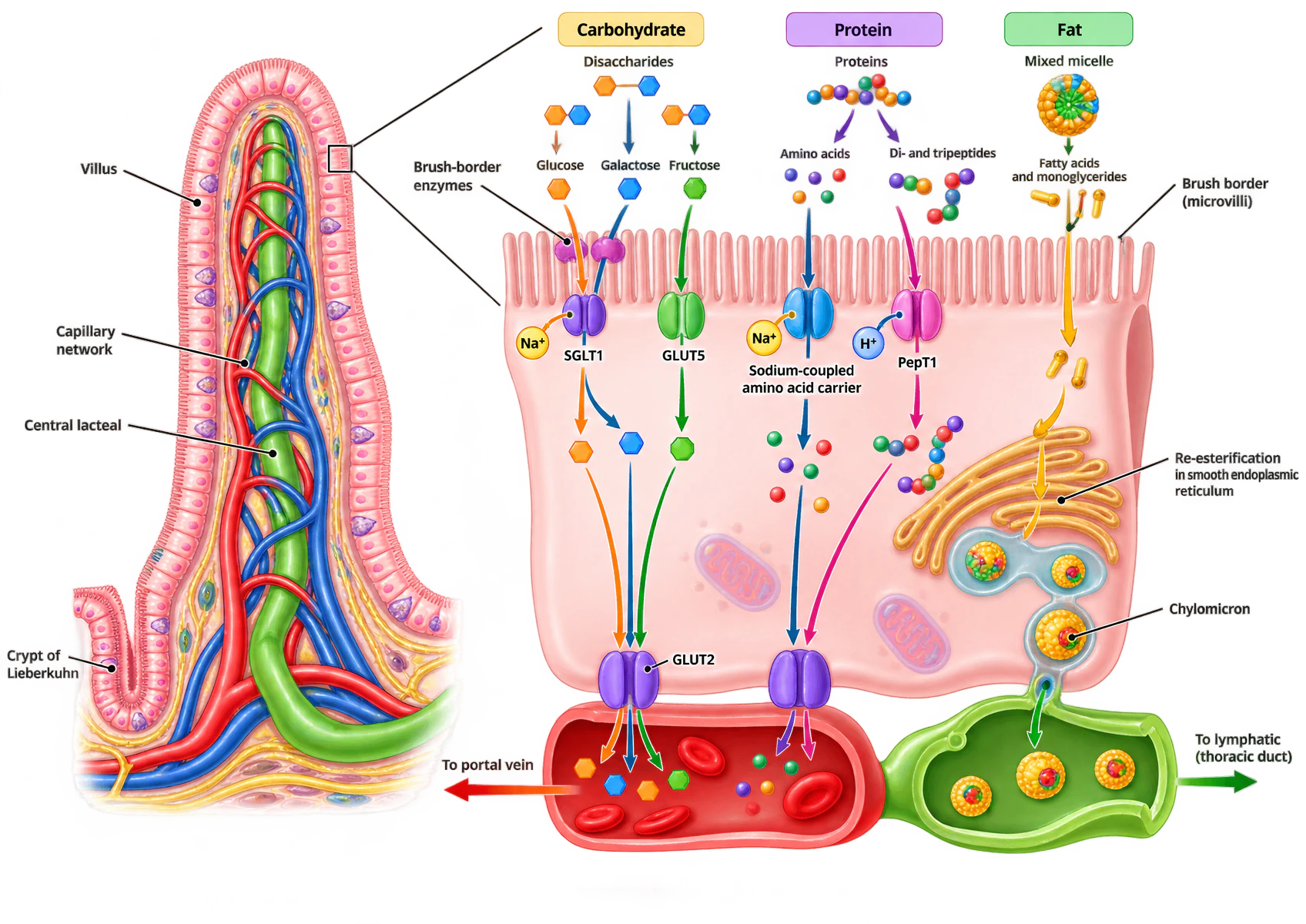
On the left, a single intestinal villus in section, with a crypt of Lieberkuhn at its base, a capillary network in red and blue, and a central lacteal in green running its length. On the right, an enlarged enterocyte with its brush border of microvilli at the top and a capillary and a lacteal beneath. Three columns of pathway are drawn across it. In the carbohydrate column, disaccharides are cleaved at the brush border to glucose, galactose and fructose; glucose and galactose cross the apical membrane on SGLT1 coupled to sodium, fructose crosses on GLUT5 by facilitated diffusion, and all three leave through GLUT2 in the basolateral membrane into the capillary, labelled to the portal vein. In the protein column, proteins are broken to amino acids and to di- and tripeptides; amino acids cross on a sodium-coupled carrier and peptides on PepT1 coupled to hydrogen, and both leave basolaterally to the same capillary. In the fat column, a mixed micelle delivers fatty acids and monoglycerides which diffuse in, are re-esterified in the smooth endoplasmic reticulum, packaged into chylomicrons, and released into the lacteal, labelled to the lymphatic and thoracic duct.
- In the mouth, salivary alpha-amylase begins the breakdown of starch. It works optimally at the pH of saliva and manages up to about three-quarters of the starch before gastric acid denatures it — protected for longer inside a food bolus than at its surface.
- In the duodenum, pancreatic alpha-amylase continues it, producing disaccharides and short oligosaccharides. Neither amylase can touch cellulose, which is why it passes through unchanged.
- At the brush border, specific integral membrane enzymes — sucrase, maltase, lactase — hydrolyse the disaccharides to monosaccharides. Only monosaccharides can be absorbed. Lactose intolerance is a deficiency at exactly this step.
- Into the enterocyte. Glucose and galactose enter only by secondary active transport on SGLT1, coupled to sodium, whose gradient is maintained by the basolateral Na⁺/K⁺ ATPase. Fructose enters by facilitated diffusion on GLUT5, using no energy at all. Pentoses enter by simple diffusion.
- Out of the enterocyte. All of them leave through GLUT2 in the basolateral membrane by facilitated diffusion, into the capillary and thence the portal vein.
Absorption
Protein
- In the stomach, pepsin — activated from pepsinogen by acid — cleaves dietary protein to shorter polypeptides. Useful but not essential; the pancreatic enzymes can do the whole job alone.
- In the duodenum, trypsin and chymotrypsin cleave those polypeptides progressively, producing dipeptides and tripeptides rather than single amino acids.
- At the brush border, peptidases cleave some of those to single amino acids.
- Into the enterocyte, by two routes. Single amino acids cross on sodium-coupled carriers, of which there are separate ones for neutral, basic and acidic amino acids. Di- and tripeptides cross on PepT1, coupled to hydrogen rather than sodium.
- Inside the enterocyte, the absorbed peptides are hydrolysed to amino acids by cytosolic peptidases, and everything leaves basolaterally by facilitated diffusion into the portal blood.
Both carbohydrate and protein products are osmotically active, so their absorption drags water with them across the epithelium. That is the second mechanism, after the sodium-glucose cotransporter, by which absorbing nutrients absorbs water — and it is why the fluid balance in section 07 depends on the digestion in sections 04 to 06 having worked.
Absorption
Fat
- Emulsification. Triglyceride is insoluble and aggregates into large droplets. Bile salts, which are amphipathic, coat those droplets and break them into progressively smaller ones. This does not digest anything; it multiplies the surface area on which lipase can act.
- Hydrolysis. Pancreatic lipase acts only at a droplet surface, hydrolysing each triglyceride to two free fatty acids and one 2-monoglyceride. Gastric and lingual lipase have already made a modest start.
- Micelle formation. The products combine with bile salts into mixed micelles, which ferry them across the unstirred layer to the brush border. Without micelles the products simply cannot reach the membrane.
- Absorption. At the enterocyte the lipid contents diffuse passively across the membrane. The bile salts stay in the lumen and travel on to be reabsorbed in the terminal ileum.
- Reassembly and export. Inside the cell, fatty acids and monoglycerides are re-esterified to triglyceride in the smooth endoplasmic reticulum, packaged with cholesterol, phospholipid and apolipoprotein into chylomicrons, and released into the lacteal — not the capillary. Chylomicrons reach the systemic circulation at the thoracic duct.
Absorption
Water, electrolytes and vitamins
| Mechanism | Where | How | When it operates |
|---|---|---|---|
| Nutrient-coupled | Small intestine | Sodium enters with glucose on SGLT1 and with amino acids on their carriers; water follows | After a meal — and the mechanism oral rehydration therapy exploits |
| Electroneutral NaCl absorption | Small intestine and colon | A sodium-hydrogen exchanger paired with a chloride-bicarbonate exchanger, so NaCl enters and no charge moves | Between meals, when there are no nutrients to couple to |
| Electrogenic sodium absorption | Distal colon | Sodium enters through ENaC, the same epithelial sodium channel as in the renal collecting duct | Under aldosterone control, and upregulated on a low-salt diet |
| Chloride secretion | Small intestine and colon crypts | Chloride enters the cell on NKCC1 and exits into the lumen through CFTR, dragging sodium and water with it | The secretory flux, which absorption normally exceeds. Cholera toxin locks CFTR open, which is the whole disease |
| Potassium | Colon | Secreted through luminal channels and down its electrochemical gradient; partially reclaimed by an H⁺/K⁺ ATPase in the distal colon | Aldosterone increases colonic potassium secretion, which is why chronic diarrhoea causes hypokalaemia |
Vitamin absorption follows the route its solubility dictates. The fat-soluble vitamins A, D, E and K are absorbed in micelles with dietary lipid, throughout the small intestine. The water-soluble vitamins are absorbed by carrier-mediated transport, mostly in the jejunum, with two site-specific exceptions that matter clinically: iron is absorbed in the duodenum, and vitamin B12 and the bile salts are absorbed in the terminal ileum. A terminal ileal resection therefore produces both vitamin B12 deficiency and bile-salt malabsorption, and the second causes both a diarrhoea and a fat-malabsorption picture.
The large intestine
The colon
| Function | How | Consequence when it fails |
|---|---|---|
| Reclaims water and electrolytes | About 1300 mL of water a day, and sodium through ENaC under aldosterone control | Diarrhoea, and hypokalaemia from continued colonic potassium secretion |
| Ferments residue | Colonic bacteria ferment undigested carbohydrate to short-chain fatty acids, which the colonocyte uses as its own principal fuel | Loss of the colonocyte's fuel supply, and part of why the mucosa atrophies without enteral contents |
| Stores | The descending and sigmoid colon hold faeces until elimination | Urgency and frequency after resection |
| Synthesises | Bacterial synthesis of vitamin K and some B vitamins | A contributor to the coagulopathy of prolonged broad-spectrum antibiotic therapy |
The ileocaecal valve guards the junction with a simple reciprocal arrangement: distension of the ileum relaxes it and distension of the caecum contracts it, so contents pass forwards and colonic bacteria do not pass back. Its competence is part of what keeps the small intestine relatively sterile, alongside the migrating motor complex and gastric acid.
The large intestine
Defaecation and continence
| Internal anal sphincter | External anal sphincter | |
|---|---|---|
| Muscle | Smooth | Skeletal |
| Control | Involuntary | Voluntary |
| Innervation | Sympathetic from L1 to L2 maintains tone; parasympathetic from S2 to S4 relaxes it | Pudendal nerve, from S2 to S4 |
| Resting state | Tonically contracted, and responsible for most of the resting anal tone | Tonically contracted, and voluntarily reinforced |
| During the reflex | Relaxes reflexly when the rectum distends — the rectosphincteric reflex | Contracts reflexly at the same moment, which is what buys the time to decide |
The sequence is worth carrying because it explains both continence and its failure. Rectal distension stimulates stretch receptors, which produces the rectoanal inhibitory reflex: the internal sphincter relaxes involuntarily, allowing the contents to be sampled by the sensitive anal mucosa, while the external sphincter contracts reflexly to prevent leakage. If the moment is convenient, voluntary relaxation of the external sphincter and puborectalis, with a Valsalva manoeuvre and the squatting posture, straightens the anorectal angle and allows defaecation. If it is not, voluntary contraction of the external sphincter returns the contents to the rectum and the urge subsides until the next mass movement. Relaxation of the internal sphincter is promoted by nitric oxide and vasoactive intestinal peptide, the same non-adrenergic non-cholinergic pair that relaxes every other sphincter in this module.
Applied
Ileus and obstruction
| Postoperative ileus | Mechanical obstruction | |
|---|---|---|
| Problem | The bowel will not contract | The bowel cannot empty past a point |
| Mechanism | Sympathetic inhibition of the enteric plexuses from surgical afferent traffic, an inflammatory response to bowel handling, and opioids acting at peripheral mu receptors | A physical lesion the contractions cannot overcome |
| Bowel sounds | Absent | Increased and high-pitched early, absent late |
| Recovery order | Small intestine first, then the stomach at about 24 hours, then the colon at 30 to 40 hours | Does not recover without relief of the cause |
| What helps | Reducing sympathetic outflow with a thoracic epidural, opioid-sparing analgesia, early enteral feeding and early mobilisation | Decompression and definitive treatment |
Consolidation
The lesson in one paragraph
The small intestine is 7 metres of the 9-metre tract carrying over 250 square metres of absorptive surface, folded three times over into valvulae conniventes, villi and microvilli. Its motility has two patterns: segmentation in the fed state, which mixes and exposes rather than propels, and the migrating motor complex in the fasted state, four phases sweeping from duodenum to ileocaecal valve roughly every 90 minutes under the control of motilin, abolished immediately by feeding and the reason the small intestine stays relatively sterile. Both are paced by interstitial cells of Cajal generating slow waves that set the maximum frequency, with neural and hormonal input deciding whether any given wave reaches threshold. The exocrine pancreas contributes 1500 mL a day from two cell types: acinar cells making enzymes and proenzymes under cholecystokinin, and ductal cells making the bicarbonate that stops gastric acid denaturing them, under secretin. Trypsinogen is activated by duodenal enterokinase and then autocatalytically, which is why intrapancreatic activation is catastrophic. Carbohydrate goes from starch through salivary and pancreatic amylase to disaccharides, is cleaved at the brush border, and is absorbed as monosaccharides — glucose and galactose on the sodium-coupled SGLT1, fructose on GLUT5 by facilitated diffusion, all leaving on GLUT2. Protein goes through pepsin and then trypsin and chymotrypsin to di- and tripeptides, absorbed both as single amino acids on sodium-coupled carriers and as peptides on the hydrogen-coupled PepT1, which is faster. Both leave in the portal vein. Fat alone does not: emulsified by bile salts, hydrolysed by pancreatic lipase to fatty acids and 2-monoglyceride, ferried in mixed micelles, absorbed passively, re-esterified in the smooth endoplasmic reticulum and packaged as chylomicrons that leave in the lacteal to the thoracic duct — which is how the fat-soluble vitamins travel and how fat bypasses hepatic first pass. The intestine is presented with 9000 mL of fluid a day, only 2000 mL of it drunk, and reclaims 8800 mL of it — 98% — leaving 200 mL in stool, by nutrient-coupled and electroneutral mechanisms in the small intestine and electrogenic ENaC under aldosterone in the distal colon. Iron is absorbed in the duodenum and vitamin B12 with the bile salts in the terminal ileum. The colon reclaims water, ferments residue to the short-chain fatty acids its own cells burn, stores, and moves contents by giant migrating complexes six to ten times a day. Defaecation turns on two sphincters with different nerves — the smooth internal on autonomic supply, the skeletal external on the pudendal — and on the rectoanal inhibitory reflex, whose absence is the diagnostic finding in Hirschsprung disease. Ileus is bowel that will not contract and obstruction is bowel that cannot empty; both dehydrate the patient fast, because the secretion continues when the reabsorption stops.